

What is a thermocouple?
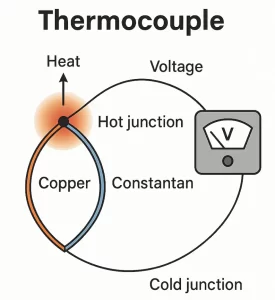
A thermocouple is a type of temperature sensor made from two different metals joined at one end. When the junction of the two metals is heated or cooled, it produces a small voltage that can be measured and used to determine temperature.
Key Features:
Basic Principle: Based on the Seebeck effect, where a voltage is generated due to a temperature difference between two dissimilar metals.
Structure: Two wires made of different metals (e.g., copper and constantan) joined at one end (called the hot junction), while the other ends (the cold junction) are connected to a measurement system.
Types: Common types include Type K, J, T, E, etc., each suited for different temperature ranges and environments.
Applications: Used in furnaces, engines, industrial processes, and even in household appliances like ovens and heaters.
The most common types of thermocouples, including their materials, temperature ranges, and typical applications:
- Type K (Nickel-Chromium / Nickel-Alumel)
- Range: –200°C to +1260°C
- Accuracy: ±1.5°C
- Pros: Most common, inexpensive, good for general use
- Applications: Furnaces, engines, metal processing
- Type J (Iron / Constantan)
- Range: –210°C to +760°C
- Accuracy: ±2.2°C
- Pros: High sensitivity, good for reducing environments
- Cons: Iron can rust in moist environments
- Applications: Plastics, food equipment, older equipment
- Type T (Copper / Constantan)
- Range: –200°C to +370°C
- Accuracy: ±1.0°C
- Pros: Very accurate at low temperatures
- Applications: Cryogenics, labs, freezers
- Type E (Nickel-Chromium / Constantan)
- Range: –200°C to +870°C
- Accuracy: ±1.7°C
- Pros: Highest EMF output of common types
- Applications: Low-temperature, precision applications
- Type N (Nicrosil / Nisil)
- Range: –200°C to +1300°C
- Accuracy: ±2.2°C
- Pros: Stable in high temperatures, resistant to oxidation
- Applications: Aerospace, high-stability environments
- Type S (Platinum-Rhodium / Platinum)
- Range: 0°C to +1450°C
- Accuracy: ±1.5°C
- Pros: Extremely stable, accurate
- Cons: Very expensive
- Applications: Laboratories, pharmaceutical, high-precision industrial
- Type R (Platinum-Rhodium / Platinum)
- Range: 0°C to +1450°C
- Accuracy: ±1.5°C
- Very similar to Type S, with slightly higher Rhodium content
- Applications: High-temperature industrial and research
- Type B (Platinum-Rhodium / Platinum-Rhodium)
- Range: 0°C to +1700°C
- Accuracy: ±0.5°C at high temps
- Pros: Excellent for very high temps, doesn’t degrade easily
- Applications: Glass, metals, and ceramics industry