


What is an RTD?
An RTD (Resistance Temperature Detector) is a type of temperature sensor that measures temperature by correlating the resistance of the RTD element with temperature. As temperature increases, the resistance of the metal (usually platinum) increases in a predictable way.
How It Works:
- RTDs rely on the principle that metallic resistance increases with temperature.
- The most common RTD is the Pt100, which has 100 ohms resistance at 0°C.
Key Features:
- Material: Typically, platinum (others include nickel and copper).
- Accuracy: Very high—more accurate and stable than thermocouples over moderate temperature ranges.
- Range: Generally –200°C to +600°C.
- Output: Resistance (measured in ohms), which is then converted to temperature using calibration standards.
- Wiring: Can be 2-wire, 3-wire, or 4-wire configurations (3- and 4-wire provide better accuracy by compensating for lead resistance).
Advantages:
- Excellent repeatability and stability
- Linear response
- Suitable for precision temperature measurements
Disadvantages:
- More expensive than thermocouples
- Slower response time
- Less rugged for extreme environments
Applications:
- Industrial process control
- HVAC systems
- Laboratory and calibration equipment
- Food and pharmaceutical manufacturing
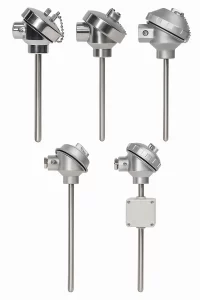
Discover our range of RTDs Pt100, Pt1000, and more models, with immediate availability and specialized technical support.
Request a quote today and ensure the performance your process needs!